Holding On and Letting Go: The Role of Uke
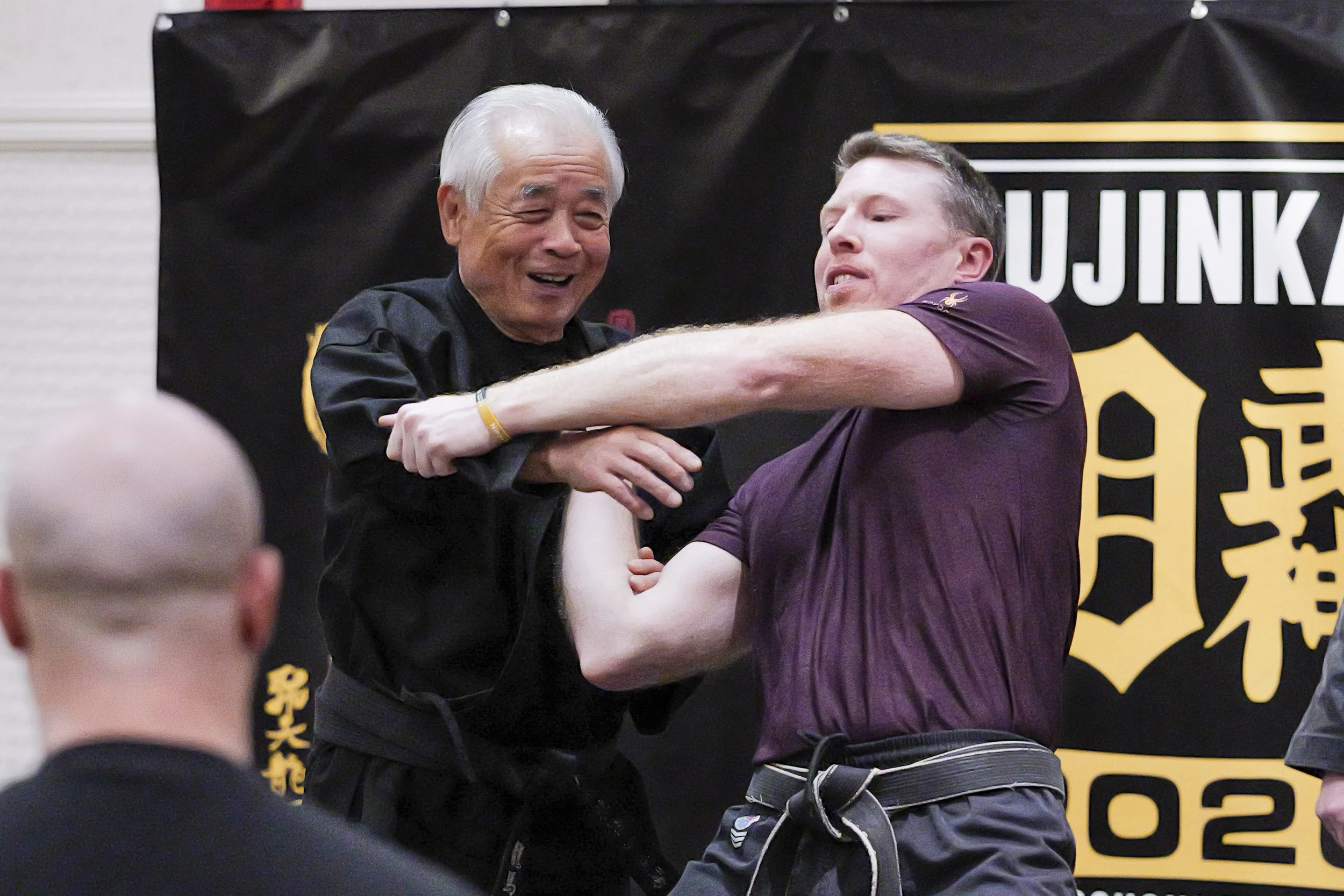
When we work on techniques in grappling range we usually start by having our training partners grab us in some way. This inevitably leads to problems. Some people will hold onto you as if their lives depend on it, while others can hardly be bothered to hold on at all and will let go completely as soon as you begin to move. Both of these extremes represent a misunderstanding of the role of uke, and as such they are unproductive and highly annoying. So let’s take a look at why and how we grab each other in training and see if we can clear up some of these issues.
The role of uke is basically threefold: Stay safe, help the tori, and be realistic, in that order. Knowing that, let’s consider a basic single lapel grab as a setup for omote gyaku. Let’s assume you know how to receive omote gyaku safely and focus on how we balance the concerns of helping the tori and being realistic.
Now most basic setups for learning omote gyaku involve taking a step to draw the opponent out and pressing the gripping hand off your chest to free yourself from their grip on your lapel. Say it’s my turn to practice, and you grab my lapel. I lightly cover your hand and take a step backward. You open your hand as I move away, letting go of me completely. Did that help me? Not really. Was it realistic? Not terribly.
Let’s say I ask you to hold more tightly and we try it again. This time when I step away, you get dragged along for the ride, but when I go to drive your hand off my chest I find that you’ve got a death grip on my gi. I struggle a bit, trying to get your hand to release, but I can’t manage it. Perhaps I reset and try it again, probably with the same result. Or perhaps I just give up on getting your hand off me and finish the omote gyaku with your hand still gripping my lapel.
Now, did that help me? Well it’s probably a lot more helpful than just letting go. I think there’s a case to be made for learning to do omote gyaku with the person still holding onto you. But I’d say there’s room for improvement. After all, I’m trying to learn how to perform omote gyaku, not how to release my training garment from a death grip, aren’t I? But what about realism? Wouldn’t it be unrealistic for you to let me free myself from your grip when you know that if you were really holding on I wouldn’t be able to? Isn’t that just letting me deceive myself into thinking I’m capable of something I’m not? I think this is the point where a lot of people get confused.
The confusion arises, I think, because of a failure to distinguish a training scenario from a fighting scenario. If I ask you to grab my lapel so I can practice omote gyaku, that is a training scenario. I’m asking you to grab me so I can work through the mechanics of a technique I’m trying to learn, which, once I’ve learned it, can be applied to fighting scenarios. If I’m standing still and letting you grab my lapel, we are not simulating fighting, because in a fight that would be stupid.
In a training scenario, you, as uke, are a practice dummy. You may be an alert, reactive, skillful practice dummy, but you’re still a practice dummy. You’re not trying to win, you’re trying to be helpful. You’re giving me a body to practice on in the position I need it to be in to practice what I’m trying to practice.
So when I step back and try to drive your hand off my chest, if you hold on for all you’re worth, you’re in the mindset of a fighting scenario. And that’s fine, as long as we’re both clear that that’s what we’re doing. But get ready, because if we’re working on a fighting scenario, I’m not going to struggle to get your hand off my chest, because in a fight that would be stupid. I’m going to punch you in the throat and let your hand open by itself. Then I’ll do my omote gyaku.
Now let’s consider some other common training situations.
When working specifically on escaping methods such as tehodoki or taihodoki, it’s alright to grab more firmly. Once the basic techniques have been learned, it’s helpful to learn to apply them against a fully committed grip. This holds true for wrist grabs, bear hugs, chokes, and similar attacks. Since the whole point of working on these methods is to learn to free oneself from grips of various kinds, the more powerful the grip, the better the technique required to escape it. But even working on grip escapes, you need to consider the level of your training partner.
When working with beginners, grabbing too tightly is counterproductive because it will encourage the use of strength to substitute for the technique they have not yet developed. Remember that helping the tori learn is higher priority than being realistic.
When working on grappling techniques and throws, it’s common to begin from a situation we refer to as kumiuchi in which uke and tori have both taken hold of each other in the same fashion, usually grabbing the collar or lapel with one hand and the elbow or sleeve with the other. This is a neutral situation in the sense that both parties have the ability to control the movement of the other and neither has an advantage.
It’s this mutual control that makes kumiuchi such a useful starting point. In this position, if you try to hit me with your free hand (the one I’m not grasping at the elbow), I can prevent it by pushing into your chest on that side. If you try to hit me with the other one, I can prevent it through my control of your elbow on that side. If you try to step or kick, I can feel when you try to pick up a foot or shift your weight and I can sink, push, or pull as necessary to prevent you from moving. And you can prevent me from doing all these things too, but only as long as you hold on.
So hold on! But not too tightly, because then you’ve switched the training scenario into a fighting scenario and that means I’ll have to hit you in the throat again.
Finally, whether working on a training scenario or a fighting scenario, it’s important to consider which part of the fight we’re simulating. Simulating the beginning of a fight is very different from simulating the middle, and a lot of the time when we work on learning basic techniques, we’re simulating the middle. Kumiuchi, for example, is not something that happens at the beginning of a fight. If an agressor tries to grab you, you move. You don’t stand there and let them get a grip.
So when considering whether it’s realistic to grip with everything you’ve got, consider what might have happened between the beginning part of the fight and the part that you’re currently working on. Also consider that we’re in motion in a fight, not static. If you’re punching, kicking, grabbing, or swinging something at me, chances are you’re aiming at a moving target and so your attack will not be ideal.
Becoming a good uke means becoming a considerate training partner. Consider your safety first, then consider what will be most helpful to your training partners, and then consider, in the context of these priorities, how to make your attacks and reactions more closely match those of a realistic opponent.
Originally published April 2012.
